Choosing writing software involves more than finding somewhere to type. A basic word processor can hold a manuscript, but a book also needs structure, revision and a practical way to manage material which rarely arrives in the correct order. Chapters expand, scenes move and a promising idea may belong several sections beyond the passage currently being written. AuthorsDrop suits this process because it allows the manuscript to be approached as a developing collection of connected parts. For writers who prefer to build their work gradually, that organisation is a significant reason to choose it.
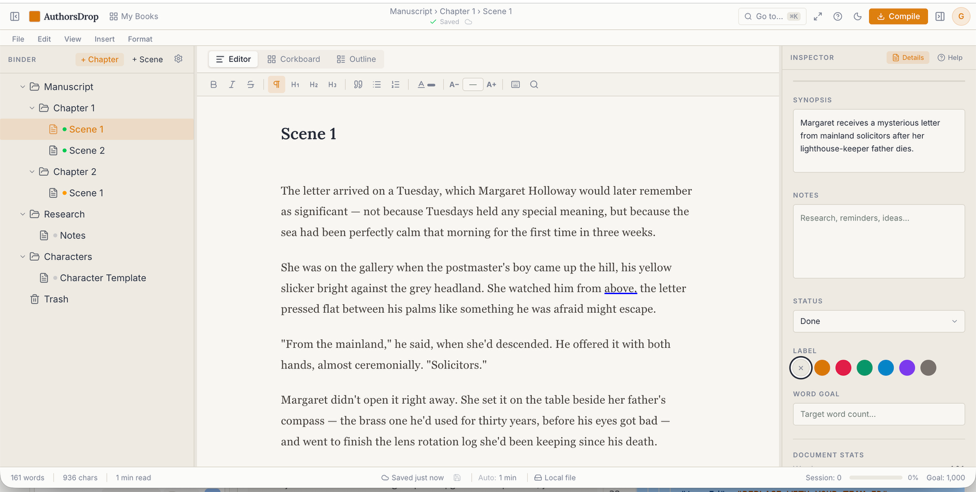
One of the difficulties of writing a long manuscript is maintaining a sense of the whole while working on its details. A paragraph may read well in isolation yet repeat an argument made earlier. A scene may be convincing but appear before the reader has enough information to understand its significance. Keeping chapters and scenes accessible makes moving between these perspectives more manageable. AuthorsDrop’s binder provides a practical means of navigating the work, helping writers return to a particular section without repeatedly searching through a continuous document. The benefit becomes more apparent as a project grows and the distance between its opening pages and its conclusion increases.
The Dropline Method offers another reason for choosing AuthorsDrop, particularly for writers who find a blank chapter an unhelpful starting point. Its progression begins with headings, develops them into sentences and paragraphs, and then builds towards fuller chapters. Each stage gives the writer a specific task. A heading establishes the subject or purpose; a sentence tests whether that purpose is clear; a paragraph begins to reveal what needs explaining, researching or reconsidering. This approach can make a substantial project easier to begin and easier to resume. It also allows structural weaknesses to become visible before thousands of words have been committed to them.
Different stages of writing require different working conditions. Planning benefits from an overview, drafting often requires sustained attention, and revision demands movement between the two. AuthorsDrop’s options for hiding the binder and inspector allow writers to adjust how much of the surrounding workspace remains visible. These controls serve a straightforward purpose: they help the writer concentrate on the task currently requiring attention. Someone examining chapter order can keep the structure available, while someone working through a difficult exchange of dialogue can give more space to the text.
AuthorsDrop also accommodates several forms of writing, including novels, non-fiction, screenplays and stage plays. That range is useful for writers whose work crosses formats, although each project still requires its own discipline. A practical guide must explain its subject clearly; a play must work through speech and action; a novel must sustain its narrative over many pages. Templates provide a starting framework, while the writer remains responsible for understanding the demands of the chosen form. Familiarity with one working environment can reduce the effort involved in changing projects, leaving more attention available for those differences.
Ultimately, the strongest reason to choose AuthorsDrop is its fit with a deliberate writing process. It supports planning, drafting and revision while keeping authorship with the person doing the work. No application can decide whether an observation is accurate, a character convincing or a chapter worth retaining. Those judgements require attention and a willingness to revise. AuthorsDrop earns its place by helping writers organise the material on which those judgements depend. For those who want to develop a book in manageable stages and keep its structure close at hand, it is a practical choice.