There is a moment at the beginning of every book when the page is empty and nobody knows what comes next. It can be uncomfortable. The sentence in your head appears weaker when it reaches the screen. The scene that seemed complete yesterday develops a hole. A character refuses to behave. The temptation to ask a machine to fill the space is understandable.
AuthorsDrop will not do that. It will not generate a chapter, continue a scene, rewrite a paragraph or manufacture a more convenient version of your voice. That absence is not a missing feature. It is a decision about what writing is and who should be responsible for it.
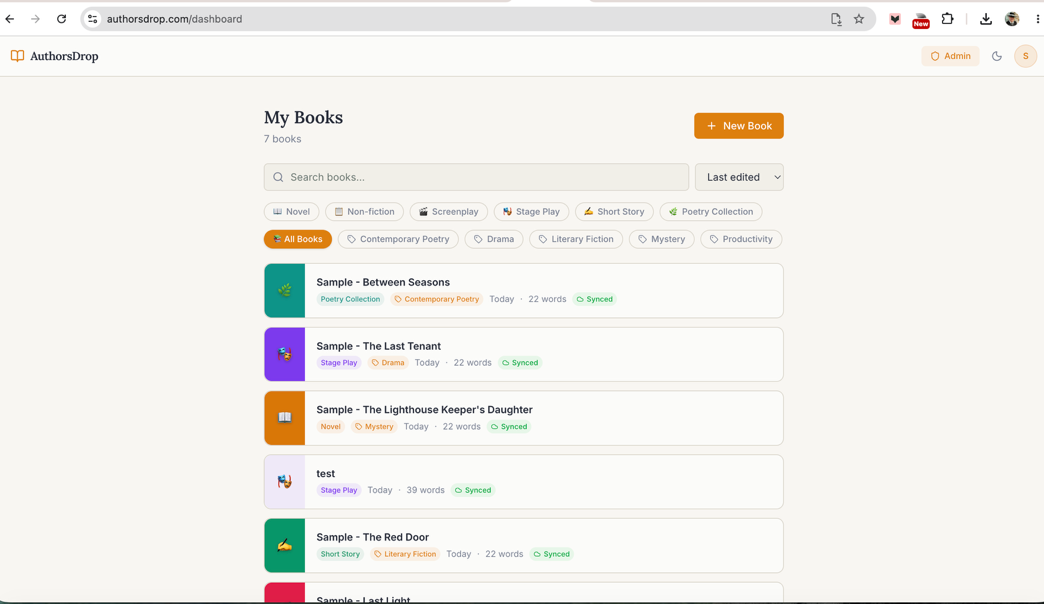
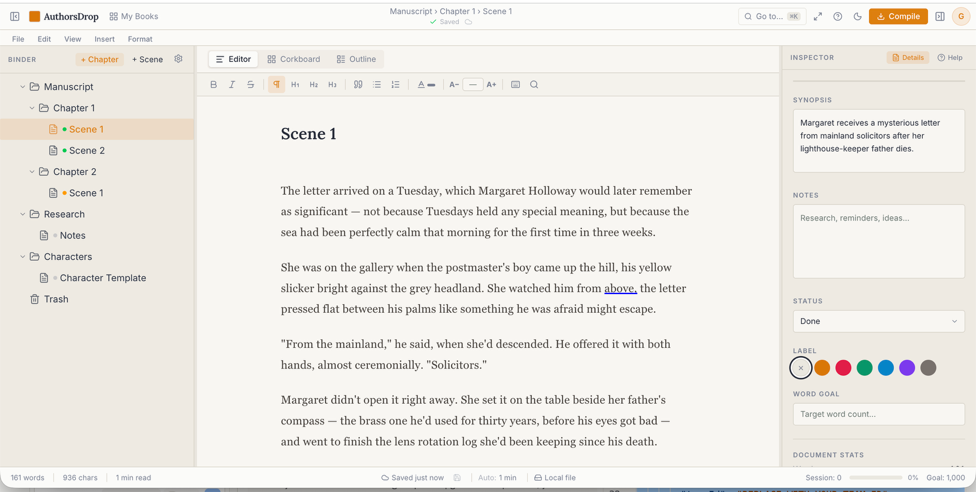
AuthorsDrop was built to help writers organise difficult work without taking the work away from them. It provides a binder for the manuscript, a corkboard for structure, an inspector for notes and a clear route from the first uncertain paragraph to a finished document. The software can hold the pieces together. The author must decide what those pieces mean.
A tool is not a collaborator
Writing software has always helped with practical tasks. A word processor saves a document, counts the words and catches a misspelling. A corkboard helps a novelist move a scene. A search box finds a forgotten name. None of these things claims to understand the book. They reduce friction while leaving judgement with the writer.
Generative AI changes that relationship. Ask it to continue a scene and it supplies prose. Ask it to improve a paragraph and it makes decisions about rhythm, vocabulary and emphasis. Ask it to strengthen a character and it begins choosing what that person notices, fears and says. The machine is no longer maintaining the desk. It has moved into the chair.
That may be useful in other settings, but AuthorsDrop is not going to present generated language as a natural extension of writing software. It is too important a distinction. Organisation supports authorship. Generated prose participates in it.
This does not mean that every writer must reject every modern technology. It means writers deserve to know precisely what a product does with their work. AuthorsDrop’s position is deliberately straightforward: it does not use generative AI to create, continue, rewrite or alter manuscript content. A manuscript is not sent to a language model for analysis, and it is not used to train one.
The difficult part has value
Most writers know the peculiar frustration of spending an hour on a paragraph that a reader will cross in twenty seconds. It is easy to regard that hour as inefficiency. It may instead be the place where the book becomes specific.
During revision, a writer discovers that the obvious word is wrong, the neat explanation is dishonest or the planned ending has not been earned. These discoveries do not arrive because the writer produces language quickly. They arrive because the writer remains with the problem for long enough to understand it.
The pauses, failed attempts and discarded pages are part of the thinking. A sentence changes because the writer has changed their mind. A character deepens because an easy motive no longer feels convincing. A chapter is removed because the book has finally revealed what it is about. The effort is not separate from the result. It creates the result.
If software removes every uncomfortable pause, it may also remove the moment in which the writer finds something that was not available at the start. Fluency can be impressive, but fluency is not the same as insight. A book needs more than sentences that arrive without resistance.
Voice is made from choices
An author’s voice is sometimes described as a style, as though it were a selection of sentence lengths and favourite words. It is more personal than that. Voice is the result of thousands of choices about what deserves attention, what can remain unsaid and where a reader should be allowed to hesitate.
Those choices include imperfections. A human voice may be blunt in one chapter and reflective in the next. It may carry the habits of a place, a generation or a life spent doing work unrelated to literature. It can surprise even the person writing it. The irregularities are not faults to be automatically smoothed away. They are often the evidence that somebody particular is speaking.
When every rough edge is treated as a defect, books begin to sound competent in the same way. The sentences are orderly, the transitions arrive on time and nothing remains long enough to trouble the reader. The prose may be clean, yet strangely difficult to remember.
AuthorsDrop should help a writer see the book more clearly without deciding how the book should sound. The binder can show that a chapter is in the wrong place. The corkboard can reveal that three scenes perform the same job. The inspector can preserve the thought that explains why a decision was made. None of those tools needs to impersonate the writer.
Readers are buying more than words
A reader does not usually choose a book because it contains the required number of sentences. The reader is entering an agreement with another mind. A memoir promises that somebody has examined a life. A novel promises that somebody has imagined consequences for people who never existed. Even a practical guide carries the judgement of a person who has selected what matters and accepted responsibility for the advice.
That relationship becomes less clear when substantial parts of a book are generated without the reader knowing. The question is not whether a machine can arrange plausible language. It can. The question is what the reader believes they are receiving when an author’s name appears on the cover.
A real book is not made real by being printed on paper. It becomes real through intention and responsibility. Somebody chose the argument, followed the character into an awkward decision, checked the facts, changed the ending and decided that the work was ready to be read. Authorship means being answerable for those choices.
Publishing rules are already changing
This debate is not confined to writers and software companies. Publishing platforms are already drawing distinctions between human and machine-produced work. Amazon’s current Kindle Direct Publishing content guidelines require publishers to disclose AI-generated text, images and translations when publishing or republishing a book. Amazon distinguishes that material from AI-assisted work, such as using a tool to refine content the author created.
Amazon has not publicly announced that every manuscript is being scanned to decide who wrote it, and AuthorsDrop will not claim that it has. Automated detection is a difficult and contested area. It would be irresponsible to frighten writers with certainty where none has been provided.
What is clear is the direction of travel. Platforms, publishers and readers are asking more questions about provenance, rights, quality and disclosure. Amazon already requires a declaration. IngramSpark’s catalogue rules also identify content created through automated means, including AI-generated and mass-produced material, as a catalogue-integrity concern. Scrutiny is not likely to become less important as generated books become easier to produce.
A writer using AuthorsDrop will not need to wonder whether the software secretly generated part of the manuscript. There is no invisible co-author inside the editor. The product’s role is visible: organise the work, protect the process and help the writer reach a finished manuscript without replacing the person doing the writing.
A promise about the product
“No AI” should not be a vague badge placed on a sales page. It should describe the behaviour of the product. For AuthorsDrop, it means no button that writes the next paragraph, no automatic rewriting disguised as improvement, no generated character development and no manuscript sent to an AI service for analysis or training.
It also means resisting an easy commercial temptation. Generative features are fashionable and simple to advertise. They produce an immediate demonstration because words appear as soon as a button is pressed. The quieter value of a well-organised manuscript takes longer to show. It becomes apparent months into a project, when the writer can still find the original idea, understand the structure and return to the work without reconstructing it from scattered files.
AuthorsDrop will continue to improve the practical experience of writing. It can make saving clearer, movement between chapters easier, compilation more reliable and the route between devices less confusing. Those improvements serve the author. They do not compete with the author.
The words remain yours
There will always be pressure to finish more quickly. There will always be a market for tools that promise to remove the blank page, the difficult middle and the fifth attempt at an ending. AuthorsDrop is making a different promise.
The software will give the book somewhere coherent to live. It will help the writer see its parts, preserve its notes and prepare it to leave the workspace. It will not decide what happens next. It will not imitate a voice and hand it back as though nothing important has changed.
When a reader opens a book created in AuthorsDrop, every sentence will still carry the choices of its writer. The mistakes will be human. The revisions will be human. The moments of clarity will have been earned by the person named on the cover.
That is not an old-fashioned limitation. It is the reason the book is real.